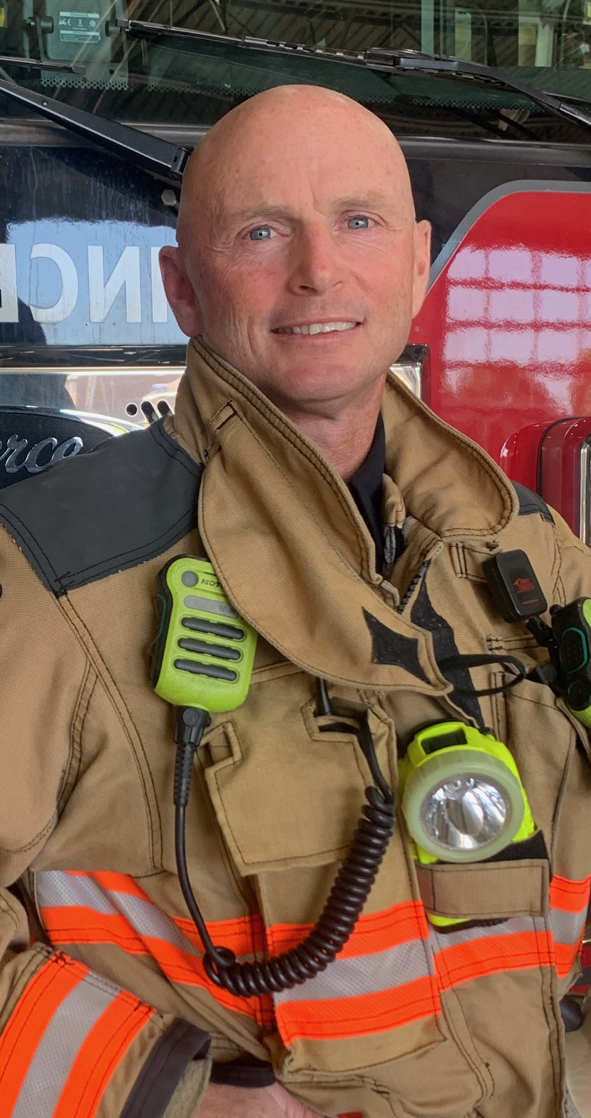
Founder & Executive Director
Derek Doyle
Full-time firefighter · 26 years on the job
DECON-TRACK was founded by Derek Doyle, a veteran firefighter with 26 years of service with the Gatineau Fire Department. Beginning his career on the front lines, Derek advanced to Chief of Procurement in 2024 before being appointed Chief of Operations in 2026.
His focus on contaminant management and first responder health is both professional and personal. Following a recent occupational sweat gland cancer diagnosis and multiple surgeries, the reality hit home. It forced a critical question: how can we protect firefighters from exposure we aren't actively tracking?
Our Mission
Advance Exposure Tracking
Improve the accuracy and accessibility of real-time exposure tracking for first responders.
Enhance Safety & Compliance
Streamline firefighter decontamination protocols to ensure full compliance with occupational safety standards.
Research contribution
DECON-TRACK exposure data, when combined with data about firefighters’ health, will allow researchers to examine statistical evidence linking contaminant exposure to occupational diseases. Such research is invaluable for mitigating long-term health risks and improving firefighter protections and support in the event of illness.
How DECON-TRACK Data Will Be Used for Research
DECON-TRACK compiles detailed exposure records for individual firefighters. By matching these records with information about the health of those same firefighters, scientists will be able to study the effects of exposure to contaminants on the likelihood of contracting occupational diseases.
Research can play a critical role in: (i) developing better exposure standards and better protection protocols; (ii) promoting the use of better protective equipment; (iii) obtaining better and more comprehensive treatment for firefighters who become ill; and (iv) expanding the recognition of occupational diseases and the scope of presumptive coverage for career, part-time, volunteer and wildfire firefighters.
DECON-TRACK aims to develop relationships with provincial and national research institutions in order to build interest in firefighter safety and to promote health research. Research institutions play an essential role because of their expertise in combining and working with different datasets; their ability to access confidential health data; and because of their networks of expert researchers who are interested in occupational health and safety, including the health and safety of firefighters.
Ahead of its launch, DECON-TRACK has reached out to Dr. Michael Haan, a Professor of Sociology at Western University and the Academic Director of Western’s Statistics Canada Research Data Centre. Dr. Haan is also the new Site Director for ICES Western (Institute of Clinical Evaluative Studies located at the Victoria Hospital in London, Ontario) which serves as a hub for health research and collaboration. Dr. Haan is a specialist in data development and linkage and has agreed to serve DECON-TRACK in an advisory capacity around data linkage (linking firefighter exposure data with health outcomes), data development and matters relating to confidentiality and data protection. Dr. Haan will also bring DECON-TRACK’s data and data links to the attention of researchers interested in firefighters’ occupational health and safety.
Firefighters will be asked to sign a Voluntary Disclosure Agreement
DECON-TRACK requires permission from firefighters to link their contaminant exposure data to their health outcomes using Social Insurance Numbers, provincial health card numbers, and demographic information consisting of name, date of birth and sex. This data will be gathered directly from firefighters via a Voluntary Disclosure Agreement that they will be asked to sign. The Agreement explains why the data is needed and how it will be protected. It also assures firefighters that not signing the agreement has no negative consequences. It’s up to each individual firefighter to decide whether to share personal information or not.
Occupational cancers recognized as linked to firefighters, depending on the province.
Recognized occupational cancers affecting firefighters, depending on the state.
What DECON-TRACK makes possible
Practical tools to support firefighters' health and safety with structured, traceable documentation for insurers, workers' compensation authorities and municipal, provincial and state leadership.
Precise individual exposure tracking
Continuous per-member exposure time with server-backed records, not reconstructed from memory after the call.
Stronger decontamination protocols
Guidance when special substances are present, to support preventive decontamination steps on scene.
Real-time operational decisions
Command staff can see when to withdraw a member, reduce repeated overexposure, and act before thresholds are crossed.
Complete exposure history
Per firefighter, per incident, and per site. Departments can use for reports, insurance, and medical follow-up.
Municipal decision support
City-wide visibility into exposure patterns, reassignment when thresholds are reached, and support for occupational health decisions.
Adaptable to local protocols
Each municipality can align settings to its own operational and industrial protocols.
The mission
Built for firefighters, by a firefighter.
We cannot eliminate every danger in our profession. But we can document exposure; research how it affects us; and work to reduce the risks and their impact on firefighters.